



What Are You Looking For?

Oil and gas operations depend on constant visibility. From drilling and production to refining and transportation, engineers and operators rely on accurate, real-time information to keep processes running safely and efficiently. At the center of this visibility are industrial displays — specialized monitors designed to perform reliably in some of the harshest operating environments in the world.
As digital monitoring systems continue to replace manual inspection and legacy controls, industrial displays have become a core component of oil and gas monitoring systems, supporting everything from SCADA visualization to on-site equipment diagnostics.
Unlike standard commercial monitors, industrial displays are built specifically for continuous operation and demanding conditions. In oil and gas facilities, displays are often exposed to vibration, dust, temperature extremes, humidity, and long operating hours. Failure is not just inconvenient — it can lead to safety risks and costly downtime.
Industrial displays act as the visual interface between operators and complex control systems. They translate raw data from sensors, PLCs, and monitoring software into clear dashboards, alarms, and trend charts that operators can understand at a glance. This ability to quickly interpret system status is critical when decisions must be made in seconds rather than minutes.
Manufacturers such as Oscy Monitor focus on industrial-grade display solutions designed for reliability, customization, and long service life, making them well suited for oil and gas monitoring applications.
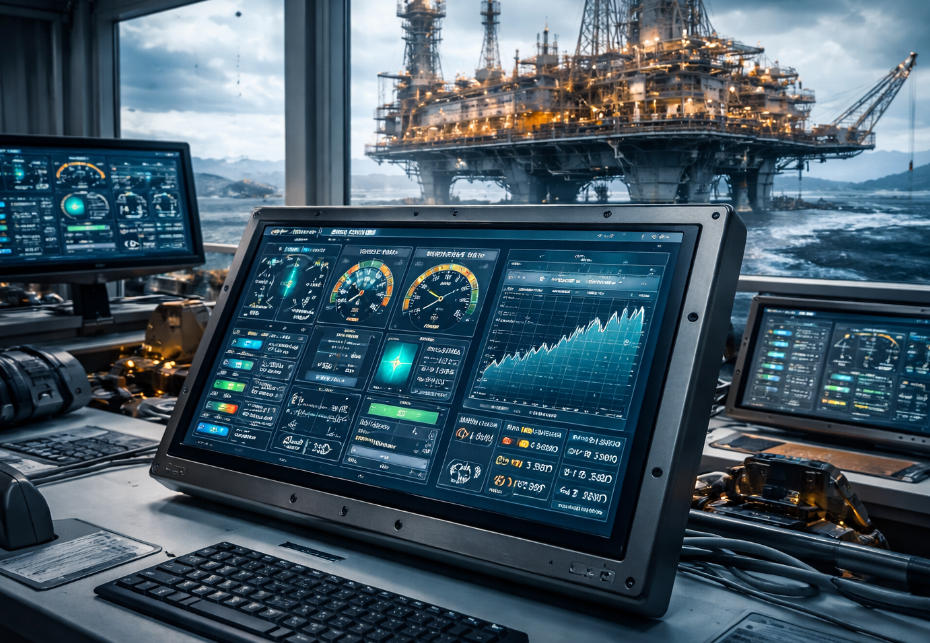
One of the defining characteristics of industrial displays in oil and gas systems is durability. These monitors are typically housed in rugged metal enclosures and engineered to operate across wide temperature ranges. Offshore platforms, desert pipelines, and refinery floors all present environmental challenges that consumer displays simply cannot handle.
Sealed front panels and industrial-grade components help protect displays from dust, moisture, and mechanical stress. In many installations, these features significantly reduce maintenance requirements and extend operational lifespan — a major advantage in remote or difficult-to-access locations.
Touchscreen technology has become increasingly common in oil and gas control environments. Industrial touchscreen displays allow operators to interact directly with monitoring software, adjust parameters, acknowledge alarms, and navigate system views without external input devices.
Depending on the application, displays may use resistive touch for glove-friendly operation or capacitive touch for higher sensitivity and multi-touch gestures. In both cases, the goal is the same: faster interaction, fewer errors, and improved workflow efficiency.
In control rooms and local HMI stations, touch-enabled industrial displays help reduce complexity and shorten response times during critical operating events.
Oil and gas facilities are not always well-controlled indoor spaces. Displays may be installed outdoors, in brightly lit process areas, or in dim control rooms operating 24/7. Industrial displays address these challenges with high brightness panels, wide viewing angles, and anti-glare coatings.
Clear visibility ensures that alarms, trends, and system indicators remain readable from different positions and distances. This is especially important in shared control rooms where multiple operators monitor the same screens.
Industrial displays are designed to integrate smoothly with existing oil and gas infrastructure. They support standard industrial interfaces such as HDMI, VGA, USB, and serial connections, making them compatible with SCADA systems, DCS platforms, and industrial PCs.
This flexibility allows displays to be deployed across a wide range of monitoring applications, from centralized control rooms to localized equipment panels. In modern digital oilfield environments, industrial displays also play a role in visualizing IIoT data and supporting predictive maintenance strategies.
By presenting real-time operating data and alarms clearly, industrial displays help operators detect abnormal conditions early. This reduces reliance on manual checks and allows teams to respond quickly to potential hazards.
User-friendly interfaces minimize training time and simplify daily operations. Operators can access critical information faster, reducing delays and improving overall system efficiency.
Designed for continuous 24/7 operation, industrial displays offer higher reliability and longer service life than standard monitors. This lowers total cost of ownership and supports uninterrupted monitoring.
Industrial displays are used throughout the oil and gas value chain, including:
Drilling and well monitoring stations
Refinery process control rooms
Pipeline monitoring and leak detection systems
Offshore platform control panels
Equipment diagnostics and maintenance terminals
In each case, the display serves as a critical link between digital systems and human decision-making.
Selecting the right industrial display for oil and gas monitoring systems requires careful consideration. Environmental conditions, mounting requirements, screen size, touch technology, and connectivity all play a role. Many suppliers offer customization options, allowing displays to be tailored for specific installations or OEM applications.
Working with experienced industrial display manufacturers ensures that the selected solution meets both operational and regulatory requirements while delivering long-term performance.
Industrial displays are no longer just accessories in oil and gas monitoring systems — they are essential tools for safe, efficient, and data-driven operations. By providing reliable visualization, intuitive interaction, and rugged performance, these displays support better decisions and help protect both personnel and assets.
As oil and gas operations continue to evolve, high-quality industrial displays will remain a key investment in operational reliability and safety.



 IPv6 network supported