



What Are You Looking For?

In modern industrial environments, predictive maintenance has quickly evolved from a forward-looking concept to a core operational strategy that maximizes uptime, extends equipment life, and drives efficiency. At the same time, industrial displays — from rugged human-machine interface (HMI) panels to smart dashboards — are playing a crucial role in transforming raw machine data into actionable insights visible to operators, engineers, and maintenance teams. In this article, we explore how industrial displays support predictive maintenance, enhance decision-making on the factory floor, and contribute to fewer unplanned shutdowns.
Predictive maintenance uses real-time sensor data and analytics to forecast when equipment components are likely to fail, enabling maintenance teams to service assets before failures occur. Unlike reactive or schedule-based maintenance, predictive approaches are data-driven and can significantly reduce costs associated with unplanned downtime and emergency repairs. This method leverages the Industrial Internet of Things (IIoT), machine learning, and advanced dashboards that visualize complex datasets in intuitive formats.
However, all this data is only as valuable as the insights people can derive from it — which is where industrial displays come in.
Industrial displays — including LCD and touch screen HMIs built for rugged environments — are no longer just simple output devices. Today’s advanced displays serve as the central visualization and control hub of predictive maintenance systems:
Industrial displays collect machine performance data (such as temperature, vibration, pressure, and operational cycles) and present it on real-time dashboards. Trend lines, color-coded indicators, gauges, and alerts help operators spot early signs of wear or anomalies — long before a component actually fails.
For example, a vibration signature that has gradually increased over time may indicate a bearing going out of tolerance — a trend that can be visible on an HMI screen tied to predictive analytics. This visual insight allows teams to schedule maintenance proactively, reducing unplanned stops.
Industrial displays can be configured to trigger visual alarms when critical operating parameters exceed pre-set thresholds. An HMI panel might flash a highlighted area or popup a maintenance reminder when a motor’s operating temperature climbs above normal patterns, signaling that an intervention may be needed soon.
These alerts help shorten response times and reduce production losses from unnoticed degradation.
Modern industrial displays interface seamlessly with PLC (Programmable Logic Controllers), SCADA (Supervisory Control and Data Acquisition), and MES (Manufacturing Execution Systems). This integration ensures that live sensor feeds and machine metrics are mirrored on display panels across the facility, providing consistent visibility for predictive maintenance workflows.
By combining real-time data from IIoT devices with visualization systems, manufacturers gain a holistic view of machine health that is essential for accurate prediction.
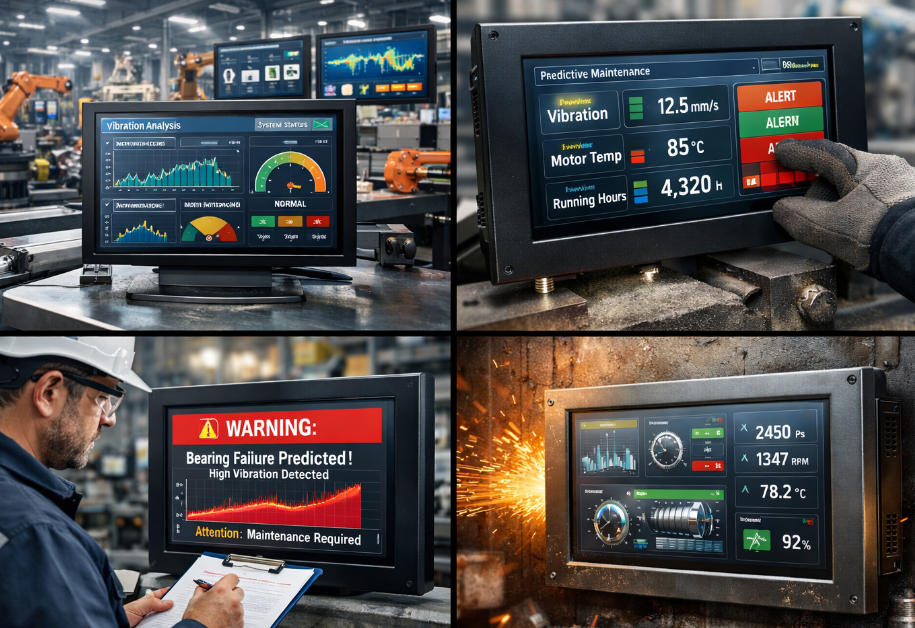
The latest industrial touch panels and HMIs add advanced data interaction capabilities that go beyond static information display:
Operators can drill down into specific assets directly from a display — for example, tapping on a machine icon to see trend graphs of temperature, load, or cycle count over time. These trend charts help detect patterns that may be precursor signs of failure, such as gradually increasing spindle vibration.
Many industrial displays now support remote access, enabling maintenance engineers to view dashboards or control interfaces off the factory floor via secure connections. Remote diagnostics reduce travel time and allow specialists to interpret issues from afar, accelerating problem resolution.
Advanced displays can also integrate with analytics engines or edge-AI processors that continuously analyze data streams and apply anomaly detection algorithms. Such setups can forecast estimated remaining useful life (RUL) of components and automatically elevate maintenance flags based on predictive models.
This smart visualization — using statistical trends and AI-enhanced insights — empowers teams to make decisions based on when maintenance should occur, not merely if it should occur.
Industrial environments are inherently tough — with extreme temperatures, dust, vibration, and continuous operation. Displays used in predictive maintenance must be engineered to withstand these conditions:
Products like those from Oscy Monitor, built with rugged components and wide temperature tolerances, offer reliable performance in demanding settings (e.g., –10 °C to 60 °C continuous operation). Their robust metal housings and vibration resistance ensure stable uptime on factory floors.
Oscy’s industrial LCD and touch monitors provide multiple interfaces (HDMI, VGA, USB, BNC) and mounting options that make integration into control systems and machine panels straightforward. Custom branding and touch capabilities make them well suited for use as predictive maintenance dashboards at the point of decision
With options ranging from small 7-inch embedded displays to larger 22-inch screens, industrial monitors can be deployed strategically across production lines and control rooms without excessive cost, enabling pervasive monitoring coverage.
Industrial displays amplify the impact of predictive maintenance in multiple measurable ways:
Reduced Unplanned Downtime: By providing early warnings visually, displays help teams act before failures cause stoppages.
Improved Equipment Lifecycle Management: Real-time and historical data enable better decisions about part replacement and repair timing.
Enhanced Collaboration: Visual dashboards serve as a single source of truth for operators, maintenance technicians, and managers.
Faster Troubleshooting: Intuitive graphical interfaces reduce diagnostic time, especially when integrated with IoT and analytics.
Industrial displays are critical enablers of predictive maintenance. Through rugged design, real-time visualization, integrated analytics, and simple interface workflows, they turn complex machine data into actionable insights that reduce downtime and support smarter maintenance strategies. Whether deployed as HMI panels on the factory floor or as dashboards in central control rooms, these displays help close the gap between data collection and decision-making — unlocking the full potential of predictive maintenance in today’s smart factories.
By choosing industrial displays that deliver reliability, flexibility, and connectivity, manufacturers strengthen their predictive maintenance capabilities and lay a foundation for ongoing operational excellence.



 IPv6 network supported